Will FIFA Review 64-Team World Cup Proposal After 2026 Tournament?
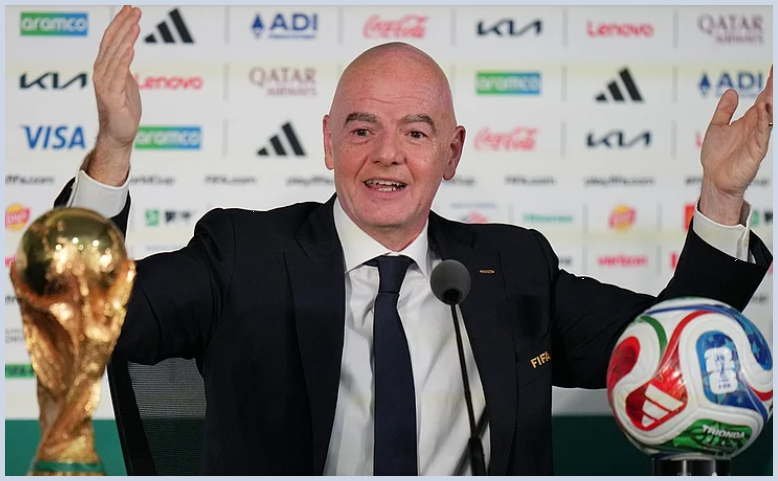
FIFA World Cup expansion could take another major step forward after FIFA president Gianni Infantino confirmed the governing body will consider increasing the men's tournament to 64 teams once the 2026 edition concludes.
The upcoming review comes as football continues to broaden its global reach, with FIFA aiming to create more opportunities for nations that have traditionally struggled to qualify for the world's biggest football competition.
FIFA to Assess 64-Team World Cup Proposal
The 2026 FIFA World Cup, co-hosted by the United States, Canada and Mexico, is already making history as the first tournament to feature 48 teams instead of the previous 32.
However, FIFA is now preparing to explore whether another expansion could be introduced in time for the 2030 World Cup.
Speaking to Swiss media outlet Bluewin, Infantino revealed that the proposal would be discussed by FIFA's decision-making committees after evaluating the success of the 2026 tournament.
According to the FIFA president, the World Cup should represent every region of the globe rather than being dominated by a handful of traditional football powers.
Infantino Wants Every Nation to Dream
Infantino believes expanding the competition would give more countries a realistic opportunity to compete on football's biggest stage.
He argued that smaller football nations need the motivation that comes with the possibility of qualifying for a World Cup.
The FIFA chief noted that football standards continue to improve across every continent and insisted that greater participation would accelerate the sport's growth worldwide. In his view, allowing more nations into the tournament would inspire continued investment and development in emerging football countries.
48-Team Format Already Showing Positive Results
Infantino also praised the newly expanded 48-team World Cup, describing the ongoing tournament as evidence that broader participation has improved competitiveness.
He pointed out that teams from every football confederation have earned points and found the back of the net during the tournament.
The FIFA president also highlighted Africa's impressive performances, noting that nine of the continent's ten representatives advanced to the knockout rounds, a significant improvement from previous editions when far fewer African nations qualified.
For Infantino, those results reinforce the argument that expanding access allows more countries to showcase their progress on the global stage.
How the 64-Team Proposal Emerged
Calls for a 64-team World Cup first gathered momentum in March 2025 when South American football body CONMEBOL proposed expanding the centenary edition of the tournament in 2030.
Later that year, Infantino met with CONMEBOL president Alejandro Domínguez, alongside senior football officials from Argentina, Paraguay and Uruguay, to discuss the idea.
Domínguez publicly backed the proposal, saying football's 100th anniversary deserved a celebration that included as many nations as possible and reflected the game's truly global appeal.
Not Everyone Supports Expansion
Despite gaining support from South America, the proposal has divided football's leadership.
Concacaf president Victor Montagliani previously questioned whether another expansion would benefit the competition or the already crowded international football calendar.
UEFA president Aleksander Čeferin has also voiced strong opposition, describing the idea of a 64-team World Cup as a poor direction for the tournament.
Their concerns centre on fixture congestion, scheduling challenges and preserving the quality and prestige of the competition.
What a 64-Team World Cup Would Mean
If FIFA eventually approves the proposal, the tournament would grow to 128 matches, twice as many as the 64-match format used between 1998 and 2022, and considerably more than the 104 games scheduled under the current 48-team structure.
The 2030 FIFA World Cup is already set to be a landmark edition as it celebrates the competition's centenary.
Uruguay, Argentina and Paraguay will each stage an opening fixture before the tournament shifts to its main hosts, Morocco, Portugal and Spain.
An expanded 64-team tournament could allow those South American nations to host full group-stage matches rather than just a single opening game, further enhancing their role in the historic competition.
While no final decision has been made, FIFA's post-2026 review will determine whether the World Cup is set for another historic transformation.




💬 Comments (0)
No comments yet. Be the first!
Leave a Comment