Why UEFA's Growing Rift with FIFA Is Unlikely to End Gianni Infantino's Reign
The relationship between UEFA and FIFA has rarely looked more strained.
European football's governing body has become increasingly vocal in its criticism of Gianni Infantino's leadership, with fresh disagreements exposing a widening divide over the future direction of world football. From controversial governance decisions to tournament policies and political symbolism, the two organizations appear to be moving further apart.
Yet despite UEFA's mounting opposition, the reality is that Infantino's grip on FIFA remains stronger than ever. While Europe continues to challenge many of FIFA's recent decisions, support from the rest of the football world means the FIFA president is unlikely to face any serious threat ahead of the next presidential election.
UEFA Draws a Line Over the Balogun Decision
The latest chapter in the ongoing UEFA vs FIFA dispute came after FIFA's controversial Balogun decision, which prompted a fierce response from European football's governing body.
UEFA accused FIFA of going too far, declaring that the world governing body had "crossed a red line." Officials described the ruling as unprecedented, incomprehensible, and impossible to justify, arguing that it undermined football's governance and decision-making processes.
The statement reflected growing frustration within UEFA, which believes FIFA has increasingly acted without sufficient consultation on major issues affecting the global game.
A Rivalry That Has Been Building for Years
The disagreement over Balogun is far from an isolated incident.
Tensions between UEFA and FIFA have steadily escalated over the past few years, with several high-profile clashes exposing deep political differences between the organizations.
One of the most dramatic moments occurred during the FIFA Congress in May 2025.
UEFA president Aleksander Ceferin led a group of European delegates in walking out during a scheduled break after Infantino arrived more than two hours late.
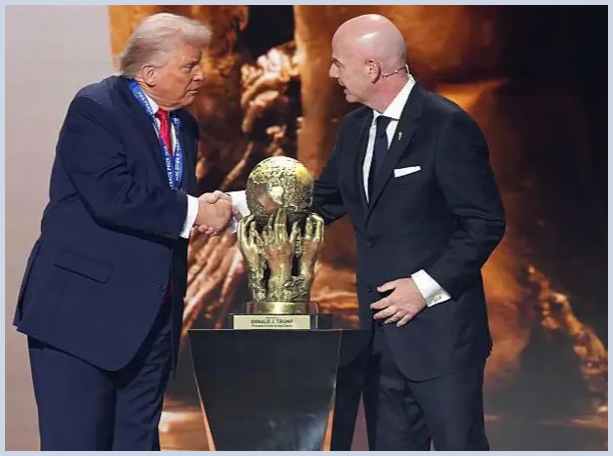
The FIFA president had been accompanying former U.S. President Donald Trump on a diplomatic visit across the Middle East before eventually joining the congress. His delayed arrival was viewed by several European officials as disrespectful to member associations.
The walkout became one of the clearest public signs that relations between the two governing bodies had significantly deteriorated.
Political Messages Throughout the World Cup
The rivalry has extended well beyond boardrooms.
Throughout the 2026 FIFA World Cup, UEFA has repeatedly used opportunities to contrast its own competitions with FIFA's approach.
One notable example involved Somali referee Omar Artan.
Soon after Artan returned home following his World Cup involvement, UEFA announced that he would officiate the UEFA Super Cup between Paris Saint-Germain and Aston Villa on 12 August.
Many observers viewed the appointment as more than a routine refereeing selection, interpreting it as a symbolic show of support.
UEFA has also consistently highlighted the affordability of Euro 2028 tickets, drawing comparisons with the significantly higher prices charged during the FIFA World Cup.
At the same time, the European governing body has emphasized that the upcoming European Championship will not introduce several controversial tournament policies associated with FIFA, including:
- Hydration breaks during matches.
- Red cards for players who cover their mouths while speaking.
Although never officially framed as direct criticism, the repeated comparisons have reinforced UEFA's effort to present its competitions as more fan-friendly and traditional.
Infantino's UEFA Roots Have Not Prevented Conflict
Ironically, Gianni Infantino built much of his football administration career within UEFA.
Before becoming FIFA president in 2016, he spent years serving as UEFA's general secretary and became a familiar face to football fans worldwide by conducting the UEFA Champions League draws.
While he has not been completely isolated from his former colleagues, he delivered a speech at the UEFA Congress earlier this year, the relationship is clearly no longer as close as it once was.
The political divide between FIFA and UEFA has become increasingly difficult to ignore.
Why Infantino's Position Remains Extremely Secure
Despite criticism from Europe's football establishment, there is little indication that Infantino's leadership is under genuine threat.
Outside Europe, the FIFA president enjoys widespread support from national football associations, largely because of his investment in developing the global game.
The Impact of FIFA Forward
One of Infantino's most influential initiatives has been the FIFA Forward Programme, which has delivered funding to football associations across every continent.
The programme has financed infrastructure projects, youth development, training facilities, coaching education, and grassroots football initiatives in nations that previously struggled to access significant investment.
For many smaller associations, FIFA has become their primary source of football development funding.
That financial support has created considerable goodwill toward Infantino across the global football community.
Expanded World Cup Has Changed Everything
Perhaps Infantino's biggest political success has been expanding the FIFA World Cup from 32 to 48 teams.
While many European critics questioned the quality of a larger tournament, the expansion created opportunities for countries that had rarely, if ever, dreamed of qualifying.
Sixteen additional places were introduced, with most allocated to confederations outside Europe.
The Election Numbers Strongly Favor Infantino
Ultimately, FIFA elections are decided by votes, not public opinion.
Every one of FIFA's 211 member associations receives a single vote during the presidential election.
A candidate requires 106 votes to secure victory. Infantino's support is already comfortably beyond that threshold.
Earlier this year, CONMEBOL publicly confirmed that all 10 South American associations would support his re-election.
Soon afterwards, the Confederation of African Football (CAF) unanimously backed him with support from 54 member associations. The Asian Football Confederation (AFC) then pledged the backing of its 47 national associations.
Together, those commitments already provide Infantino with 111 confirmed votes, enough to secure another term before counting support from Europe, North America, Oceania, or additional federations.
Could UEFA Mount a Serious Challenge?
In theory, UEFA could attempt to field an alternative candidate.
In practice, doing so would be extremely difficult.
Infantino was re-elected unopposed in both 2019 and 2023, reflecting the overwhelming confidence many member associations continue to place in his leadership. Given his current global backing, any challenger in the 2027 FIFA presidential election would face an enormous uphill battle.
Unless an extraordinary political shift occurs within world football, UEFA's criticism is unlikely to translate into electoral success.
The Verdict
The UEFA vs FIFA rivalry shows no signs of fading. Disagreements over governance, tournament policies, finances, and football's future are likely to continue in the coming years.
However, while UEFA remains one of football's most powerful institutions, FIFA is ultimately a global organization whose leadership is determined by all 211 member associations, not Europe alone.
That reality leaves Gianni Infantino in an exceptionally strong position. His investment in football development, expansion of the FIFA World Cup, and overwhelming support from Africa, Asia, and South America have created a political foundation that is currently unmatched.
For now, UEFA may continue to challenge FIFA's decisions, but removing Infantino from office appears to be a far more difficult task than criticizing his leadership.

💬 Comments (0)
No comments yet. Be the first!
Leave a Comment