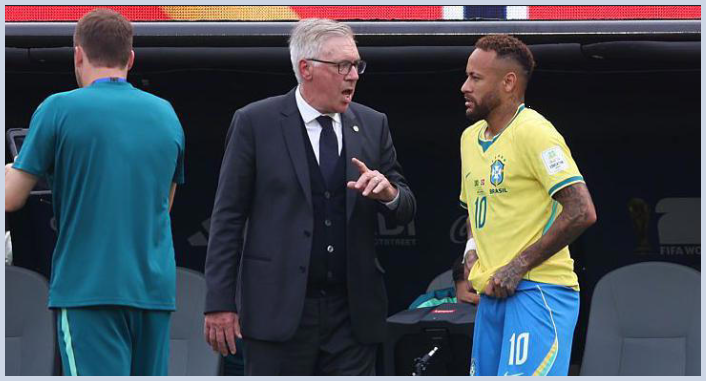
Brazil’s World Cup Collapse Exposes Deep Problems: Can Ancelotti Lead the Rebuild?
Brazil's latest World Cup campaign ended not with heartbreak, controversy, or bad luck—but with a harsh reality check.
For decades, the Seleção have been synonymous with brilliance, flair, and footballing excellence. Yet their defeat to Norway at the 2026 FIFA World Cup felt less like an unfortunate setback and more like a warning sign that the country's footballing identity is at a crossroads.
Four years ago, Brazil were edged out by Croatia in the quarter-finals after a match many felt could have gone either way. Before that, they suffered a narrow defeat to Belgium under similarly frustrating circumstances. This time, however, there were no excuses.
They did not even reach the last eight.
And unlike previous exits, there was little debate about whether they deserved better.
The loss to Norway exposed fundamental weaknesses that have been developing for years, leaving serious questions about the future of Brazilian football, and whether Carlo Ancelotti is the right man to oversee the transformation that now seems unavoidable.
Brazil’s World Cup Failure Was More Than a Bad Result
When Ancelotti took charge following Brazil's humiliating 4-1 defeat to Argentina in March 2025, he inherited a team lacking confidence and direction.
The Italian quickly stabilized the situation.
In 16 matches as head coach, he recorded 10 wins, three draws and three defeats. More importantly, he steadied a side that had struggled badly during World Cup qualification, having lost four of their previous five matches before his arrival.
Those improvements initially suggested Brazil were moving in the right direction.
Yet the World Cup revealed deeper issues that short-term fixes could not solve.
Ancelotti's arrival may have acted as a temporary remedy, but Brazil's problems require something far more substantial than tactical adjustments and improved morale.
The team now needs a complete rebuild.
The Midfield Crisis Is Hurting Brazil
Perhaps the most alarming aspect of Brazil's decline is the deterioration of a position that once defined the nation's footballing identity.
For generations, Brazil produced creative midfielders capable of controlling matches with elegance and imagination. Names like Zico, Sócrates, Rivaldo, Ronaldinho and Kaká embodied the country's unique style.
Today, that creative heartbeat appears to be fading.
Against Norway, Brazil were comprehensively outplayed in midfield. Watching the Seleção struggle to retain possession while Norway dictated the tempo was a startling sight for football fans accustomed to Brazil dominating the ball.
The issue is not merely tactical.
It reflects a broader structural problem within Brazilian football.
Casemiro's Return Brought Stability, but Also Limitations
One of Ancelotti's first major decisions was recalling Casemiro after an 18-month absence from international football.
The veteran midfielder certainly provided leadership and organization.
His presence allowed Bruno Guimarães to operate with greater freedom and influence, and before his costly missed penalty against Norway, the Newcastle United star had been among Brazil's standout performers at the tournament.
However, Casemiro's declining mobility remained a concern.
His struggles in open spaces were evident throughout the competition and contributed to Brazil's increasingly cautious defensive approach.
Rather than pressing aggressively, Brazil often dropped deeper and allowed opponents to dictate possession.
Norway exploited that hesitation brilliantly.
Brazil's Creativity Problem Runs Deeper
The injury suffered by Lucas Paquetá against Japan further highlighted Brazil's lack of midfield depth.
Paquetá offered qualities no other player in the squad could replicate.
Ancelotti openly admitted as much after the match.
With the midfielder unavailable, Arsenal forward Gabriel Martinelli was drafted into the starting lineup. While Martinelli brought pace and energy, the adjustment altered the entire balance of the team.
Brazil became heavily reliant on counterattacks and direct transitions rather than controlled possession and creativity through central areas.
The problem was made worse by squad construction.
Ancelotti initially selected only five midfielders in his World Cup squad, a decision that ultimately backfired.
Even after injury concerns forced him to add Ederson, the imbalance remained obvious.
Still, the blame cannot rest solely with the coach.
Brazil continues to produce an abundance of talented wide forwards and wingers, but the pipeline of elite central midfielders has noticeably slowed.
That trend is becoming increasingly costly on the international stage.
The Neymar Gamble Backfired
If the midfield issues were partly structural, the handling of Neymar was entirely Ancelotti's responsibility.
The legendary forward remained one of the most debated figures in Brazilian football heading into the tournament.
Despite growing evidence that age and injuries had diminished his influence, public pressure for his inclusion remained immense.
Ancelotti initially insisted that selection would be based solely on merit and fitness.
Yet Neymar was ultimately included despite concerns over both.
His brief appearance against Scotland raised eyebrows, with many observers noting that he looked far removed from the player who once dazzled defenders across Europe.
Even so, Ancelotti turned to him again in a crucial knockout match.
Neymar's Inclusion Disrupted Brazil's Attack
Accommodating Neymar forced significant tactical changes.
Because he no longer possessed the energy to contribute defensively, he was deployed as a central striker.
That decision pushed Vinícius Júnior and Endrick into wider and deeper positions, reducing their impact in dangerous attacking areas.
Instead of maximizing Brazil's most explosive attacking talents, the tactical reshuffle limited their effectiveness.
The knock-on effect was felt throughout the team.
Brazil became more open defensively, creating opportunities for Norway to supply quality service to Erling Haaland.
Given even the slightest opportunity, the Manchester City striker rarely needs a second invitation.
Neymar eventually scored from the penalty spot, but his overall performance reflected a player nearing the end of an extraordinary career.
At one stage, he was fortunate to avoid a red card following a reckless challenge that appeared to reflect growing frustration.
The End of an Era for Neymar?
Following the defeat, Neymar strongly hinted that his international career may be over.
Reflecting emotionally on the moment, he suggested that the journey which began at the same stadium during his Brazil debut in 2010 had finally reached its conclusion.
If that proves true, it will mark the end of one of the most influential chapters in Brazilian football history.
At his peak, Neymar was among the world's finest players, a footballer capable of producing moments of pure genius.
However, every era eventually comes to an end. And Brazil now appears ready to enter a new one.
Ancelotti Faces the Biggest Challenge of His Career
Despite the disappointment, Ancelotti remains determined to move forward.
The veteran coach insists the current setback should serve as motivation rather than despair.
He believes progress has been made and remains committed to finding new solutions as Brazil prepare for the future.
With qualification for the 2030 FIFA World Cup expected to be considerably less demanding—especially with Argentina, Uruguay, and Paraguay already guaranteed participation as centenary hosts, Brazil have time to rebuild.
The question is whether Ancelotti should be the architect of that reconstruction.
Fixer or Rebuilder?
Throughout his illustrious career, Ancelotti has earned a reputation as one of football's greatest problem-solvers.
His success across Europe's biggest clubs has often come from refining existing squads rather than completely rebuilding them from the ground up.
That distinction matters. Brazil's situation requires more than subtle adjustments.
It demands difficult decisions, generational change and a reimagining of the national team's identity. Ancelotti's long-term contract suggests the Brazilian Football Confederation believes he can oversee that process.
But following this disappointing World Cup exit, uncertainty remains.
The coming years will determine whether he is the man capable of leading Brazil back to the summit of world football or whether his role was simply to steady the ship during a turbulent period.
For now, one thing is certain: the road to 2030 has already begun.

💬 Comments (0)
No comments yet. Be the first!
Leave a Comment