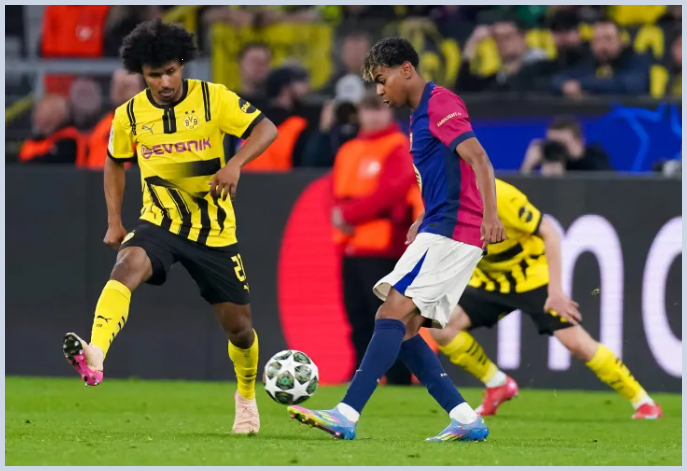
Could Karim Adeyemi’s Move to Barcelona Signal a New Role for Lamine Yamal?
Barcelona's transfer strategy this summer suggests the club may be preparing for a major tactical shift rather than simply replacing departing stars with like-for-like signings.
With Anthony Gordon, Karim Adeyemi, and long-term target Julian Alvarez all linked with the Catalan giants, manager Hansi Flick appears to be building an attack based on versatility, movement and collective goalscoring rather than relying on a single prolific striker.
If Robert Lewandowski leaves and Barcelona fail to land Alvarez, Adeyemi's arrival could become even more significant. More importantly, it may pave the way for Lamine Yamal to evolve into a central attacking role.
Hansi Flick's Vision Goes Beyond Replacing Lewandowski
For years, Lewandowski has been Barcelona's main source of goals, regularly producing 40 or more in a season. However, Flick's recruitment strategy hints at a different philosophy.
Instead of searching for another striker capable of matching Lewandowski's output alone, Barcelona appears keen on building an attack where several players contribute between 15 and 20 goals each over the course of a campaign.
This approach has been a hallmark of Flick's coaching career. During his time with Germany's World Cup-winning setup under Joachim Löw and later at Bayern Munich, where he guided the club to a historic sextuple, goals came from every area of the pitch rather than one dominant finisher.
The reported pursuits of Karim Adeyemi and Anthony Gordon fit perfectly into that blueprint.
Both forwards possess blistering pace, positional flexibility and relentless work rates. While neither is known as an elite goalscorer, they offer movement that can stretch defences and create opportunities for teammates.
Why Lamine Yamal Could Be Barcelona's Next Central Playmaker
Perhaps the biggest clue behind Barcelona's transfer activity is what it could mean for Lamine Yamal. The teenage sensation has already admitted he expects to move into a more central position as his career develops. Such a transition makes tactical sense.
Opponents have increasingly focused on stopping Yamal by assigning two or even three defenders to him whenever he receives possession on the right wing.
Although his dribbling ability still allows him to beat defenders regularly, the heavy attention often forces him into crowded areas where attacks lose momentum.
During Spain's World Cup clash with Belgium, for example, Yamal completed several successful dribbles but frequently found himself surrounded before attempting speculative efforts that rarely troubled the goalkeeper.
Operating through the middle could reduce those situations while allowing him greater influence over the team's overall play.
Flick Has Already Tested the Idea
The concept of using Yamal centrally is not entirely new. Earlier in the season, Flick deployed him as a false nine during Barcelona's thrilling 5-3 victory over Real Betis. The experiment revealed several encouraging signs.
Yamal looked comfortable carrying the ball through central areas, linked play effectively and regularly switched attacks to both wings, creating space for overlapping runners. His vision and creativity stood out immediately. There were still areas requiring improvement.
Unlike natural attacking midfielders such as Dani Olmo, Yamal occasionally held onto possession slightly longer than necessary, while his first touch under pressure lacked the sharpness expected in tight central spaces.
Nevertheless, those shortcomings appeared more related to experience than suitability for the role. His intelligence and decision-making suggest he could eventually thrive there.
Lessons From El Clasico
Another glimpse of Yamal's future came during Barcelona's Supercopa clash against Real Madrid. For much of the first half, Real left-back Álvaro Carreras coped well with Yamal's attempts to beat him down the flank.
After the interval, however, the youngster began drifting into central positions instead. The tactical adjustment completely changed the game.
Carreras found himself uncertain whether to follow Yamal inside or hold his defensive line, creating valuable space on the wing for teammates to exploit.
This type of positional freedom mirrors the evolution of some of Barcelona's greatest attacking players.
Lionel Messi famously transformed from a winger into one of football's greatest false nines, while Neymar also became more influential whenever he was given licence to drift inside rather than remain fixed out wide. Barcelona may now envision a similar pathway for Yamal.
Where Karim Adeyemi Fits into Barcelona's Plans
If Karim Adeyemi completes a move to Barcelona, his pace and direct running would offer the perfect complement to a more central Yamal.
Rather than demanding constant possession, Adeyemi excels at making off-the-ball runs behind defenders, stretching defensive lines and opening spaces for creative teammates. His ability to play across the front three also gives Flick greater tactical flexibility.
Combined with Anthony Gordon, Raphinha and potentially Julian Alvarez, Barcelona could field one of Europe's most fluid attacking units. Instead of relying on one fixed striker, every forward would rotate positions, making the attack far less predictable.
This fluidity has become increasingly important in modern football, especially against elite opponents capable of neutralising traditional centre-forwards.
Raphinha's Role Could Also Change
Barcelona experimented with Raphinha in a central attacking midfield position last season.
Although the Brazilian performed admirably, the coaching staff soon realised they were sacrificing his greatest strengths. His pressing intensity, pace and ability to drive at defenders from the left wing proved far more valuable than using him through the middle.
With Adeyemi potentially arriving, Raphinha can continue operating in his preferred role while Yamal assumes greater creative responsibility centrally. Such balance would allow Barcelona to maximise the strengths of each attacker rather than forcing players into unfamiliar positions.
Can Barcelona Replace Lewandowski's Goals?
The biggest challenge remains replacing Lewandowski's extraordinary goalscoring record. Neither Adeyemi nor Gordon has consistently produced the numbers expected from Europe's elite strikers.
That raises an important question.
Can Barcelona generate enough goals collectively to compete for the Champions League? Against weaker opposition, Flick's fluid system could overwhelm teams through movement and quick combinations.
However, knockout football presents different challenges. Elite European defences are typically compact, disciplined and difficult to break down. Without a clinical penalty-box striker, Barcelona may occasionally struggle to convert dominance into goals. Signing Julian Alvarez would certainly ease those concerns, but if that move fails, Flick will need his tactical approach to compensate.
A New Era for Barcelona's Attack?
Barcelona's transfer strategy suggests the club is embracing evolution rather than replacement.
Instead of searching for another Lewandowski, the Blaugrana appear determined to create a dynamic frontline built around versatility, pressing and shared goalscoring responsibility.
If Karim Adeyemi joins the club, his arrival may not simply strengthen the squad, it could unlock a completely new chapter in Lamine Yamal's development.
Whether this bold tactical shift delivers domestic and European success remains to be seen, but one thing is becoming increasingly clear: Barcelona's future attack may look very different from the one fans have grown accustomed to.

💬 Comments (0)
No comments yet. Be the first!
Leave a Comment