From Cornwall to Mexico: The Story of How Miners Introduced Football to a Nation
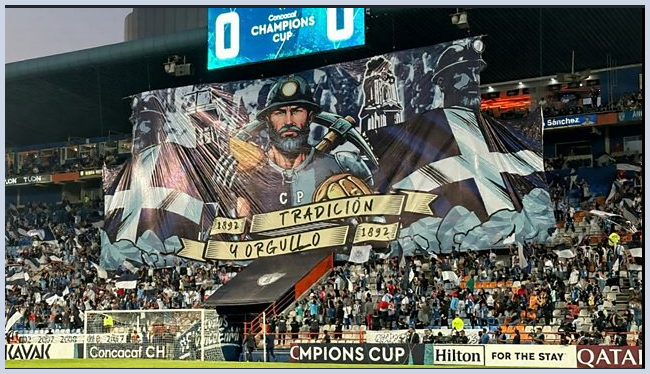
When supporters of Pachuca gather inside Estadio Hidalgo, one image often stands out among the sea of banners and club colors.
A giant tifo depicts a miner holding a pickaxe in one hand and a traditional pastry in the other. Alongside him fly black flags adorned with a white cross, unmistakable symbols of Cornwall.
For many football fans, it may seem unusual that one of Mexico’s most historic clubs proudly celebrates a connection to a region in southwest England. Yet the story behind Pachuca's origins reveals how Cornish miners played a crucial role in bringing football to Mexico and helped shape the country's sporting identity.
The Beginning of a Transatlantic Connection
The roots of this remarkable relationship stretch back more than 200 years.
Following Mexico’s war for independence from Spain, much of the country's once-thriving mining industry had fallen into decline. Mines were flooded, productivity had collapsed, and investors were searching for solutions.
In 1824, a successful Cornish mining engineer named John Taylor saw an opportunity.
Taylor had earned a reputation for reviving struggling mining operations in Cornwall, particularly around the village of Gwennap. Believing he could repeat that success in Mexico, he became involved with mines in the Hidalgo region, especially around Real del Monte.
His investment sparked a steady movement of workers between Cornwall and Mexico. Hundreds of Cornish miners and their families crossed the Atlantic over the following decades, bringing far more than mining expertise.
They also carried their customs, traditions, language, food, and sporting passions.
Cricket Arrived Before Football
Football's arrival in Mexico actually began with another sport.
During the late 1850s, before the modern rules of football had even been fully established in England, Cornish businessman and mine owner Frank Rule founded a cricket team in Pachuca.
At the time, cricket clubs often served as social hubs for expatriate communities. Football gradually emerged from those same circles.
Many players participated in both sports, and the transition from cricket to football happened naturally as the latter gained popularity throughout Britain and beyond.
According to historical records, one of the earliest references to football in Pachuca appeared in 1892 when a local newspaper reported internal disagreements within a football team.
The dispute involved players from Pachuca and Real del Monte, illustrating that football was already becoming an organized activity among the mining communities.
The Birth of Mexico's First Football Club
A major turning point arrived in 1895.
Recognizing the need for stronger organization, Frank Rule brought together several sporting groups, including the Pachuca Cricket Club, the Pachuca Football Club and the Velasco Cricket Club.
The result was the creation of the Pachuca Athletic Club.
Rule also provided land near his estate for sporting events. However, there was one condition: no matches could be played on Sundays due to his Methodist religious beliefs.
The club quickly became a focal point for football development in Mexico.
As the sport spread to other regions, clubs emerged in places such as Orizaba in Veracruz. While there remains debate over which team deserves recognition as Mexico’s oldest football club, Pachuca is widely regarded as the country's original football institution.
Creating Mexico's First Football League
By 1902, football had gained enough momentum for several clubs to establish the nation's first recognized competition.
Pachuca joined Orizaba and three other teams in forming the Liga Mexicana de Football Amateur Association.
Orizaba captured the inaugural championship, but Pachuca soon enjoyed success of its own, winning the title during the 1904-05 season.
The league laid the foundation for what would eventually become one of Latin America's strongest football cultures.
The Hidden Role of Cornish Women
While much of the focus falls on miners and footballers, Cornish women were equally important in preserving community traditions.
Matchdays became social occasions where families gathered to support their teams. Women frequently attended games wearing club colors and helping maintain a strong sense of identity within the expatriate community.
They also introduced one of Cornwall's most famous culinary exports: the Cornish pasty.
Historical references suggest that pasties were being eaten during sporting events in Pachuca as early as the nineteenth century.
For miners, the pastry was practical. Its thick crust acted as a handle for workers whose hands were often covered in dirt, while its sturdy structure made it suitable for harsh working environments underground.
Breaking Barriers in Mexican Football
Another important chapter arrived in 1908.
Pachuca welcomed its first Mexican player, David Islas, into a team that had largely been shaped by the Cornish community.
The move was encouraged by Alf Crowle, the son of a Cornish miner who later became player-manager.
Crowle earned widespread praise for helping integrate local Mexican players into the squad and breaking down social and ethnic divisions that existed at the time.
His contribution remains one of the most significant in the club's early history.
Revolution and Decline
The Mexican Revolution dramatically altered life in the region.
During the early 1920s, many members of the Cornish community left Hidalgo, including key football figures such as Crowle.
As the population changed, Pachuca struggled to maintain its player base and organizational structure.
The club participated in its final competition of the amateur era in 1922 before eventually folding.
Pachuca would later be revived in 1950, disappear again, and then return once more in 1960.
Those setbacks, however, did not prevent the club from becoming one of Mexico's football success stories.
Pachuca's Rise to Modern Success
The modern version of Pachuca has achieved remarkable accomplishments.
The club has won multiple Mexican league titles and gained international recognition by lifting the Copa Sudamericana in 2006, becoming one of the most successful teams in Mexican football.
Yet despite those achievements, supporters have never forgotten where the club came from.
Its nickname, "Los Tuzos," refers to gophers, burrowing animals that symbolize the region's mining heritage.
Across Pachuca, the term "Tuzo" appears everywhere, from local businesses to the city's public transportation system.
For fans, the mining connection remains a central part of the club's identity.
The Legacy of the Cornish Pasty
Perhaps no symbol better represents the bond between Cornwall and Hidalgo than the pasty.
Known locally as "paste," the pastry remains one of the region's most beloved foods.
Although Mexican versions often include chili and local flavors, they retain the traditional beef-and-vegetable foundation of the original Cornish recipe.
Today, shops selling pastes can be found throughout Pachuca and Real del Monte.
The region even hosts an annual International Pasty Festival and is home to a museum dedicated to the pastry's history.
Cornish flags still decorate many traditional bakeries, serving as visible reminders of a shared heritage.
A Connection That Lives On
More than a century after football first arrived in Mexico through Cornish miners, the connection remains strong.
Organizations such as Kernow FA have even explored the possibility of arranging matches between Cornish representative teams and Pachuca as a way of celebrating their common history.
Meanwhile, Mexico continues to grow as a football powerhouse and will become the first nation to host the men's FIFA World Cup three times.
As fans gather for another global football celebration, many in both Cornwall and Hidalgo will remember the unlikely journey that connected their communities.
It is a story of migration, sport, culture, and identity, proof that football's history is often shaped by people who never imagined the impact they would leave behind.
And somewhere in both Cornwall and Mexico, supporters will almost certainly be enjoying a pasty while watching the beautiful game they helped share with the world.




💬 Comments (0)
No comments yet. Be the first!
Leave a Comment